


Published Last updated Reviewed by Signal Desk editorial (systems & risk)
The biggest shift in retail trading since commission-free apps is not another mobile chart pack. It is giving third-party AI agents permissioned keys to a live brokerage account. On May 27, 2026, Robinhood said it was “now open to agents,” launching Agentic Trading and an Agentic Credit Card so customer-chosen agents can trade—and, separately, spend—through Robinhood infrastructure.
This article is a research brief for people who build or evaluate AI trading agents: what shipped, how MCP fits, what the crypto expansion actually promises, and where the product’s “safety-always” language collides with strict user liability. It is not investment advice and not an endorsement of handing capital to a language model.
What Agentic Trading actually is
Robinhood’s own framing is precise enough to quote in plain language: Agentic Trading is a product that lets you connect a third-party AI agent to a dedicated Robinhood account to automate investment decisions and order placement. Orders may be placed without your direct input on each transaction.
That last clause is the product. Classic “bots” on retail platforms are usually vendor-hosted strategies or fixed rules. Agentic Trading is closer to bring-your-own-agent (BYOA): Claude, ChatGPT, Grok, coding agents, or any MCP-compatible stack can sit on the policy side while Robinhood remains the venue, custody (for the brokerage product), and UI for monitoring.
In Signal Desk terms, this is an agent vs bot distinction at platform scale: autonomy and tool use move to the agent provider; execution and account structure stay on Robinhood. It sits inside the broader trend we call agentic finance—AI that does not only advise, but acts.
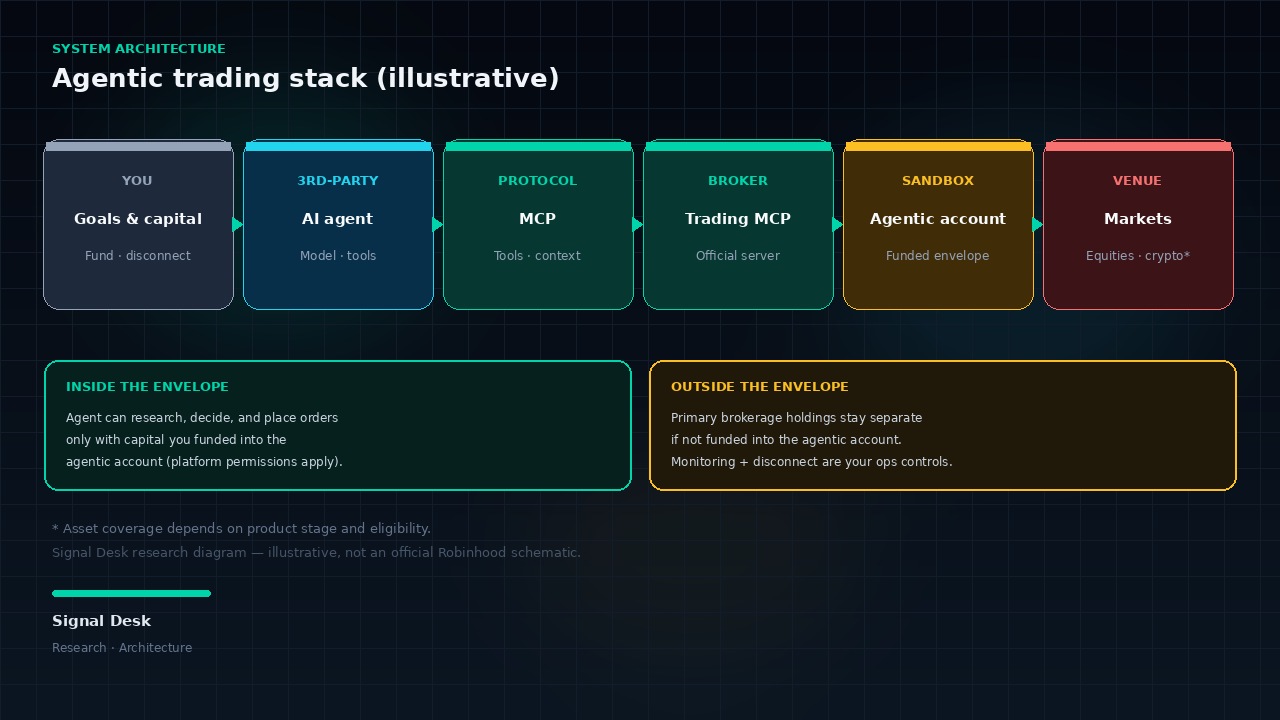
System schema
Reference architecture (product shape)
-
You Goals & capital Fund limit · disconnect
-
3rd-party AI agent Claude · GPT · Grok · MCP clients
-
Protocol MCP Tools · context · actions
-
Robinhood Trading MCP Official server
-
Sandbox Agentic account Funded envelope only
-
Venue Markets Equities · options · crypto*
*Asset coverage depends on product stage and eligibility (equities first; options later; crypto announced for U.S. rollout). Always verify live support docs.
Launch timeline (verified public milestones)
| Date | Event | Scope |
|---|---|---|
| May 27, 2026 | Newsroom: “Robinhood is Now Open to Agents” | Agentic Trading beta (equities first) + Agentic Credit Card; MCP Trading & Banking servers |
| May–June 2026 | Beta → broader customer availability (per company social / product messaging) | Equities focus; options called out as expanded by July narrative |
| July 1, 2026 | “The World is Flat” London keynote / newsroom package | Agentic Accounts for crypto for eligible U.S. users “rolling out soon,” plus Chain / stock tokens / DeFi suite |
| Early July 2026 | Press coverage of crypto expansion + adoption stat | 70,000+ agentic accounts cited from a Robinhood executive presentation |
At launch, Robinhood was explicit that Agentic Trading started equities-only in beta, with options, crypto, event contracts, futures, and more “coming soon.” The July 1 post reframes progress as Agentic Trading for equities and options already in market, with crypto next.
How it works: MCP, agentic accounts, user flow
Model Context Protocol (MCP)
MCP is an open standard for connecting AI agents to external apps and services (tool discovery, structured actions, data access). Robinhood’s pitch is that instead of brittle unofficial APIs, agents connect to official Trading MCP (and Banking MCP for the agentic card). Support docs emphasize that setup/authentication for agentic accounts is desktop-oriented—not a fully mobile-first connect path.
For systems engineers, MCP is the control-plane standard; Robinhood is the execution adapter + account sandbox. That maps cleanly onto the layered agent architecture we recommend: policy and tools on one side, risk and venue rails on the other—except here, much of the “risk product” is user-configured capital isolation plus platform monitoring, not a full independent risk service you design yourself.
Control-plane schema
Where each layer lives
- Policy Your natural-language goals and any constraints you type into the agent—quality varies with how precise you are.
- Cognition Third-party AI agent (model + tools + memory on the vendor’s side). Robinhood does not train or supervise this stack.
- Protocol MCP standardizes how the agent discovers tools and calls actions against Robinhood’s servers.
- Broker rails Trading MCP + agentic account—market context, order placement, sandbox capital, activity feed, disconnect.
- Market Exchange / venue execution under normal brokerage constraints for the supported asset class.
Builder takeaway: MCP is plumbing. It does not replace your own risk gate, evaluation ladder, or kill-switch culture on the agent side.
User flow
Setup path (conceptual)
- Pick an agentMCP-capable platform (desktop connect path)
- Link Trading MCPAuthenticate to Robinhood’s agent tooling
- Open agentic accountSelf-directed dedicated account type
- Fund the envelopeOnly capital you can afford to lose
- State constraintsSymbols, size, drawdown, pause rules
- Monitor & revokeFeed, P&L, notifications, disconnect
Exact UI steps change with product updates—follow Robinhood’s current support articles for connect and account creation.
Dedicated agentic account
The structural safety feature that actually matters: the agent is meant to operate in a separate agentic account funded with only the capital you allocate. Push notifications, a real-time activity feed, and P&L in the Robinhood apps are the primary observability surfaces. Disconnecting the agent is the hard stop.
What Robinhood says agents can do
Official examples include:
- Analyze concentration/sector exposure and rebalance
- Build and maintain thematic portfolios (e.g., AI or semiconductors) with periodic rebalance
- Backtest a mean-reversion style idea and deploy automated buy/sell rules
- For crypto (announced path): continuously scan data and execute when “the market turns,” with humans setting capital and guardrails
“Preview trades” appears in Robinhood’s safety messaging as something agents may do when appropriate—not a guarantee of human approval on every order. Do not assume a hard confirmation gate unless you configure and verify it.
Crypto expansion: why 24/7 changes the risk math
Ops comparison
Equities sessions vs crypto continuous markets
Equities-style sessions
- Defined open/close, auctions, overnight gaps
- Human ops windows align with market hours
- Agent idle overnight is often less eventful
Crypto 24/7
- Weekend cascades, funding, liquidations
- Error rate × opportunity count stays “on”
- Unsupervised hours become capital hours
Why crypto agentic accounts stress data quality, kill switches, and LLM tool risk harder than equities beta.
On July 1, 2026, Robinhood wrote that after launching Agentic Trading for equities and options in the U.S., it was preparing Agentic Accounts for crypto for eligible U.S. traders via Trading MCP, at no additional cost as stated, with rollout beginning “soon.”
Crypto is the product’s natural stress test. Equities have sessions, auctions, and overnight gaps. Crypto has continuous trading, weekend cascades, and funding/liquidation dynamics. An agent that “never sleeps” is useful precisely because humans do—and dangerous for the same reason: error rate × opportunity count × leverage of attention.
Institutional giants have long used high-frequency algorithms… To bridge this gap, we are preparing to launch Agentic Accounts for crypto… Your agent can continuously scan millions of data points and execute strategies the moment the market turns. Crucially, humans remain in control by deciding exactly how much capital to allocate and set the specific safety guardrails. — Robinhood newsroom, July 1, 2026 (paraphrase structure retained; see official post for full wording)
From a builder’s view, crypto agentic accounts will stress data quality, kill switches, and LLM-as-oracle failure modes harder than equities beta ever could. If your agent’s policy depends on news, social, or tool-fetched web content, prompt injection and stale context become capital events—not academic ones.
Safety controls vs. outcome risk

Risk schema
Access control ≠ outcome safety
What platform controls bound
- Dedicated / limited-scope agentic account funding
- Real-time activity feed, P&L, push notifications
- Instant disconnect / disable
- Fraud detection / support review narratives
- Optional previews / approvals (“when appropriate”)
What disclosures still put on you
- Possible loss of the entire agentic investment
- Agent error, misread instructions, stale/bad context
- Strategy failure; fast moves hard to stop in real time
- No guarantee of agent output; losses from agent decisions
- Data shared with AI provider under their terms
- You assume risk for orders and third-party data use
Sandboxing bounds blast radius of credentials and capital. It does not bound drawdown inside the sandbox.
If you fund $10,000 of risk capital, an agent can still lose $10,000 efficiently. Treat the agentic account like a production canary with a hard notional ceiling—not like a free research playground.
Trust boundary
Who owns which failure mode
| Surface | Typically on agent vendor / you | Typically on brokerage product |
|---|---|---|
| Model reasoning | Hallucinations, bad plans, prompt injection via tools | Does not supervise third-party models (per RH disclosures) |
| Capital scope | How much you fund; constraints you write | Agentic account isolation mechanics |
| Order placement | When the agent chooses to call trade tools | Venue routing, account status, product permissions |
| Data leaving RH | Provider terms once shared with the AI platform | Security of RH environment until share point |
| Monitoring | Whether you actually watch feeds / act on alerts | Feed, P&L, notifications, disconnect UI |
Not legal advice—a builder’s map of responsibility surfaces as described in public product language.
Early adoption and reception
Demand signals look real: coverage of the crypto expansion cited a Robinhood executive saying more than 70,000 agentic accounts opened in the first few weeks after the equities launch. That is account creation, not proven alpha.
Independent technical write-ups of the MCP surface (mid-2026) have been mixed: excitement about a major brokerage shipping official agent tooling, plus criticism of beta friction (auth flows, asset coverage gaps, “chat-window first” ergonomics). Treat those as early-builder reports, not final product judgment—betas move—but they are useful reminders that shipping MCP ≠ shipping a production trading system.
Strategically, Robinhood is racing to own the retail interface for agentic finance while bundling Chain, stock tokens, and DeFi distribution. For competitors still stuck in “AI insights” without execution permissions, this is a positioning leap. For regulators, it is a live experiment in who is liable when a non-employee model places the order.
Regulatory gray zone (what we can say carefully)
As of this writing, public coverage of Agentic Trading emphasizes that traditional broker-dealer and securities frameworks still apply to the firm, while specific rulebooks for third-party autonomous AI agents with retail execution authority are thin. Commentary has framed the launch as a de facto test case for SEC/FINRA posture. Do not confuse “allowed to ship a product” with “risk-free for the customer” or “settled supervisory doctrine for agent vendors.”
Practically: suitability, communications, supervision, and operational resilience questions will trail usage data. If you build agents that plug into Robinhood, assume documentation, audit logs, and customer-facing risk language will matter as much as sharpe ratios.
Who this is (and isn’t) for
More plausible fit
- Technically fluent users who already understand agent failure modes and can read activity feeds
- Builders testing MCP integrations with small, disposable capital
- Investors who want automation inside a hard dollar budget they can afford to zero
Poor fit
- Anyone equating “Robinhood safety controls” with “can’t lose money”
- Users who will not monitor 24/7 crypto agent behavior (when available)
- Strategies that require institutional market access, complex multi-leg options hygiene, or venues Robinhood’s agent tools do not support yet
How to apply this
How to evaluate Robinhood Agentic Trading before funding an agent.
- Read official risk disclosures. Confirm you accept no per-order approval by default, total loss possible, and no Robinhood guarantee of agent output.
- Connect MCP on desktop. Use a supported agent stack and Robinhood’s Trading MCP; follow current support steps for authentication.
- Open a dedicated agentic account. Fund only risk capital—never retirement or long-term core holdings.
- Write explicit constraints. Caps, symbols, drawdown rules, and pause conditions beat vague natural-language dreams.
- Verify monitoring and disconnect. Notifications, feed, P&L, and one-tap disconnect before size-up.
- Treat crypto as higher ops load. Continuous markets multiply both opportunity and unsupervised error.
For a 2026 product map across hosted desks, broker MCP rails, and bot platforms, see AI Trading Agent Tools in 2026.
Frequently asked questions
What is Robinhood Agentic Trading?
A product that connects third-party AI agents via MCP to a dedicated Robinhood agentic account so the agent can automate decisions and place orders, often without per-trade human approval.
When did it launch, and what about crypto?
May 27, 2026 for Agentic Trading (equities beta first) and the Agentic Credit Card. July 1, 2026 announced Agentic Accounts for crypto for eligible U.S. users, rolling out soon per Robinhood.
Does sandboxing make agent trading safe?
It limits which funds the agent can touch. It does not prevent large losses inside that envelope, nor model error, bad data, or strategy failure. You remain responsible for trades and third-party AI data use under Robinhood’s disclosures.
How should builders think about this?
As a distribution and execution adapter for agent policies—not as a complete risk system. Keep independent eval, logging, and kill discipline on the agent side; treat Robinhood’s agentic account as a capital ceiling and venue.
Bottom line
Robinhood Agentic Trading is one of the clearest retail implementations of agentic execution at U.S. brokerage scale: MCP connectivity, sandboxed capital, and a roadmap from equities into crypto’s always-on markets. Early account creation numbers suggest product-market curiosity is strong.
The honest thesis for Signal Desk readers: this can be a bridge between retail users and automation that used to require custom infra—or a high-speed path to supervised losses if natural-language goals replace risk engineering. The platform gives you a walled account and a disconnect button. It does not give you alpha, and its disclosures say so.
Next reading: how to build an agent, risk controls, and evaluation ladders before you fund anything that can click “buy” while you sleep.
Sources (primary): Robinhood newsroom — May 27, 2026; Robinhood newsroom — July 1, 2026; Agentic Trading product page; Agentic Trading overview (support); TechCrunch / Fortune / Yahoo Finance coverage of launch and crypto expansion (secondary).